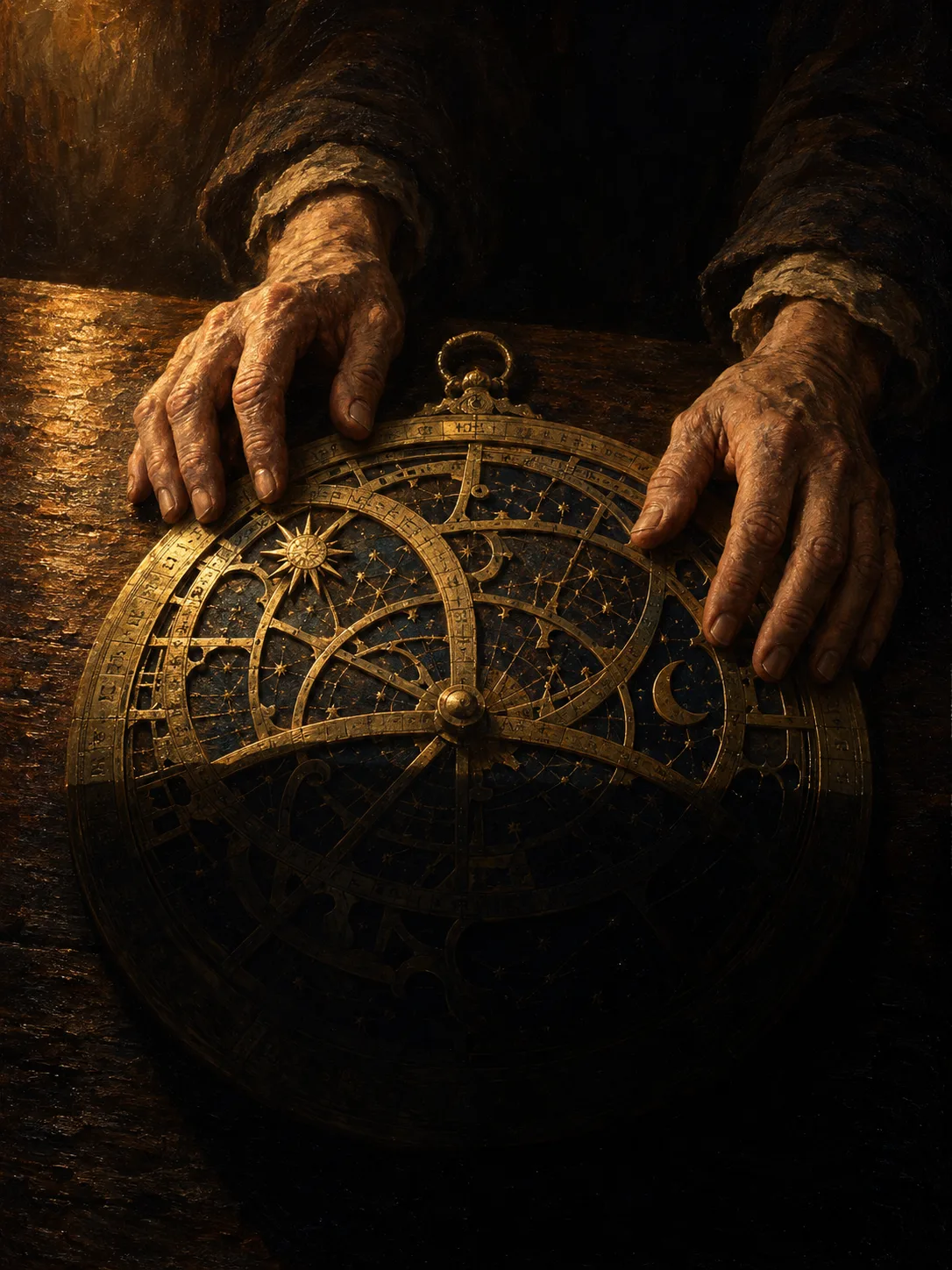
There is a way to read the stars that has nothing to do with knowing what happens next. Every morning the same motion: the chart open, the transits marked, the question asked — what is the quality of this day? Not what will it bring. What it is made of, now, while it is still being made.
The medieval schoolmen had already drawn a version of this line. Hugh of St Victor called astrology natural where it concerned the effects of the heavens upon physical things; health and illness, storm and calm, fertility and sterility, and superstitious where it claimed contingent events or things subject to free choice. William of Auvergne, Albertus Magnus and Thomas Aquinas would all, in different ways, work along the same boundary: what the heavens might incline in embodied nature, and what remained beyond their determination.
Aquinas gives the principle its sharpest form. He repeats the astrologers’ maxim: Sapiens dominabitur astris. The wise person will master the stars. This is closer to meteorology than to fatalism. You read the coming weather so you can dress for it. The forecast does not walk out of the door in your place.
᛭
Refusing to ask the sky what will happen is not a courtesy extended to make the practice sound safer for company. It is the point itself. A signature can be read. An oracle has to be pressed and interrogated, made to answer on command, and something in that posture curdles. Attention paid to what is already there is one motion. Reaching for what has not yet been given is another — standing in a room and noticing it, against standing in the same room and demanding it tell you what tomorrow holds.
So the sky is asked a narrower set of questions than it is often accused of answering. What is the tone of this stretch of time. What is under pressure. What is being invited. What ought to be worked with rather than fought. These are the things the chart is read for, carefully and repeatedly, until its patterns become familiar.
What it will not answer, because it was never asked to, is whether this will happen, what another person will do, or whether the outcome one hopes for is coming. Those questions belong somewhere else: to prayer, to waiting, to the slow and unglamorous work of deciding. The sky can tell you what kind of day you are standing in. It was never going to tell you how the day ends.