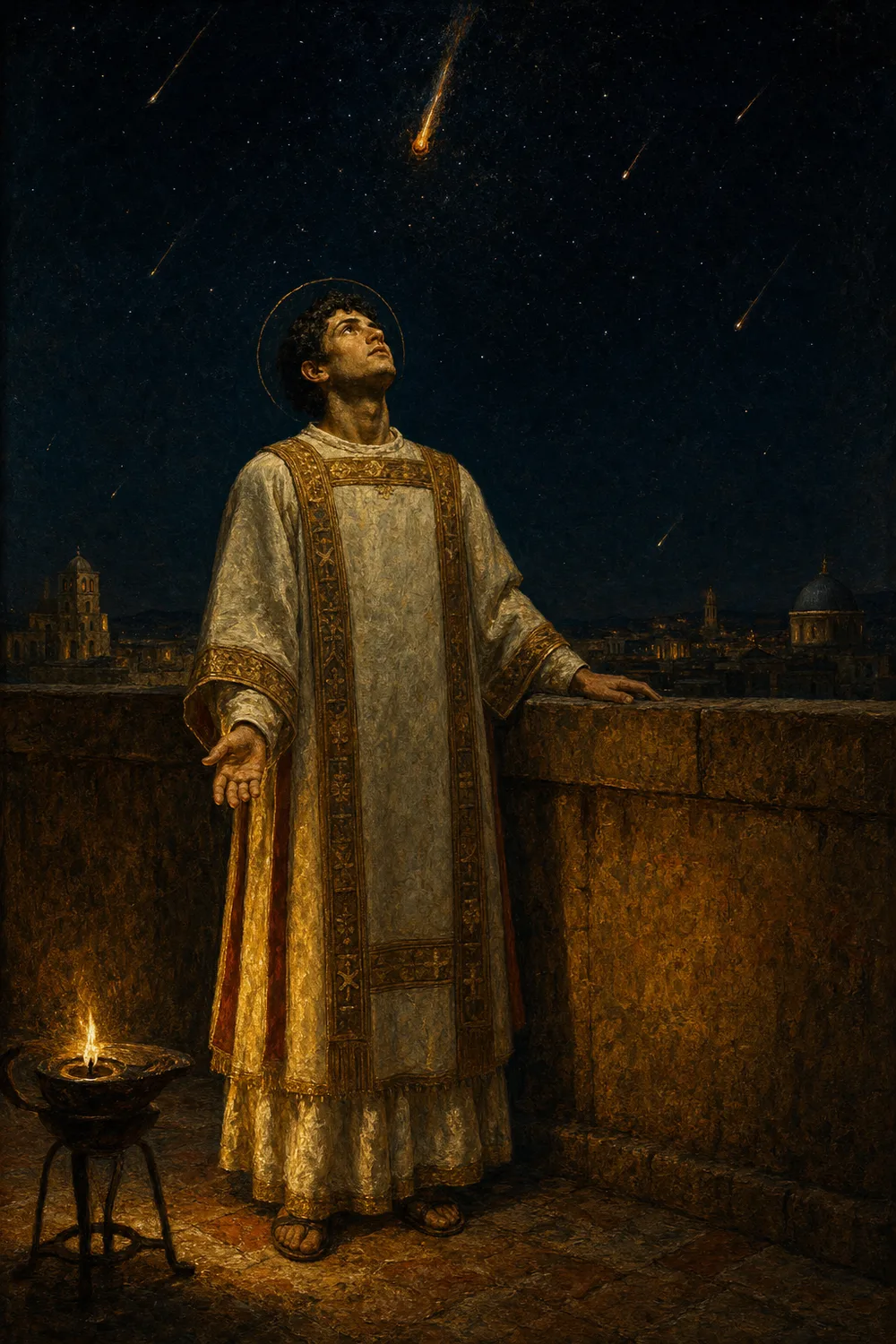
The tenth of August falls in the weight of summer. Heat accumulated in stone and earth, slow to release after dark. The nights stay warm. The sky, on a clear night, is absolute.
Lawrence was a deacon of Rome, burned on a gridiron in the year 258. The story that came down says he told his executioners, at some point in the burning, to turn him over — he was done on one side. Whether he said it or not, the Church kept the line. Something in that quality: wit in extremity, the refusal to be only what is being done to you.
᛭
On a clear August night, watch the sky long enough and it begins to move. A streak of light, gone before you can follow it — so fast that after the first you doubt yourself. Wait. A second. A third. They fall without pattern, scattered across the dark.
Stelle di San Lorenzo — Lawrence’s stars, Lawrence’s tears. The name older than any theory of why. People have stood in August courtyards with their heads back and watched fire fall on the anniversary of fire below, for as long as there has been a feast to keep.
The Church did not schedule the feast by the sky. But the feast falls where it falls, and on the night of Lawrence the sky does something visible. Not argument, not proof — coincidence that asks for a certain kind of attention.
᛭
The feast falls in Leo. The Lion is the heart of the zodiac summer — the sign the tradition has long associated with fire, with the centre, with what burns at the height of the year. Lawrence died by fire. The streaks fall like sparks. It is the kind of correspondence the tradition has always been willing to read.
The lineage of those who read it runs long. St Hildegard von Bingen — declared a Doctor of the Church in 2012 by Pope Benedict XVI — understood the created order as bearing the impress of its maker, not as allegory but as structure. The forms of nature carry meaning because they were made by the One who is meaning. The heavens, in the saint’s account, are not backdrop. They participate.
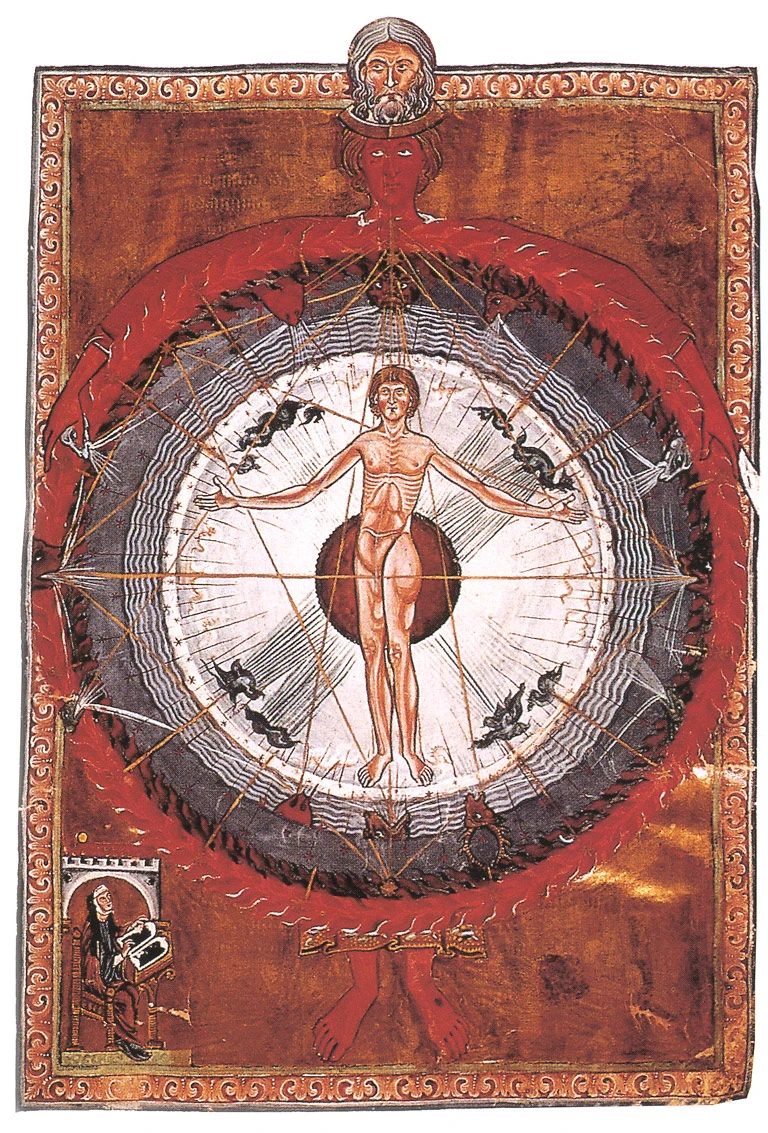
St Hildegard von Bingen’s Liber Divinorum Operum, “The Universal Man”.
Dionysius called the sun the brilliant likeness of Divine Goodness, and did not mean it as a figure of speech. Ficino wrote of the celestial bodies as divinely ensouled instruments — his word mediating names the function without claiming to explain how it works. Kepler listened for harmonic ratios, found them, built a cosmos out of proportion and called it a tabernacle. These are not eccentric positions. They mark the long centre of a tradition that watched carefully and did not look away.
What this tradition does not offer is divination. Not a method for telling fortunes, not a system for predicting outcomes. What it offers is a way of reading — the sky as one of the texts creation has always had, the feast as the night on which something in that text becomes visible. Correspondence, not control.
᛭
The feast has been kept since the fourth century. The meteors have fallen in August for longer. The tradition of reading what falls runs longer still — a line of witnesses standing outdoors at night, looking up, recording what they find.
I will be outside on the tenth. Watching what comes.