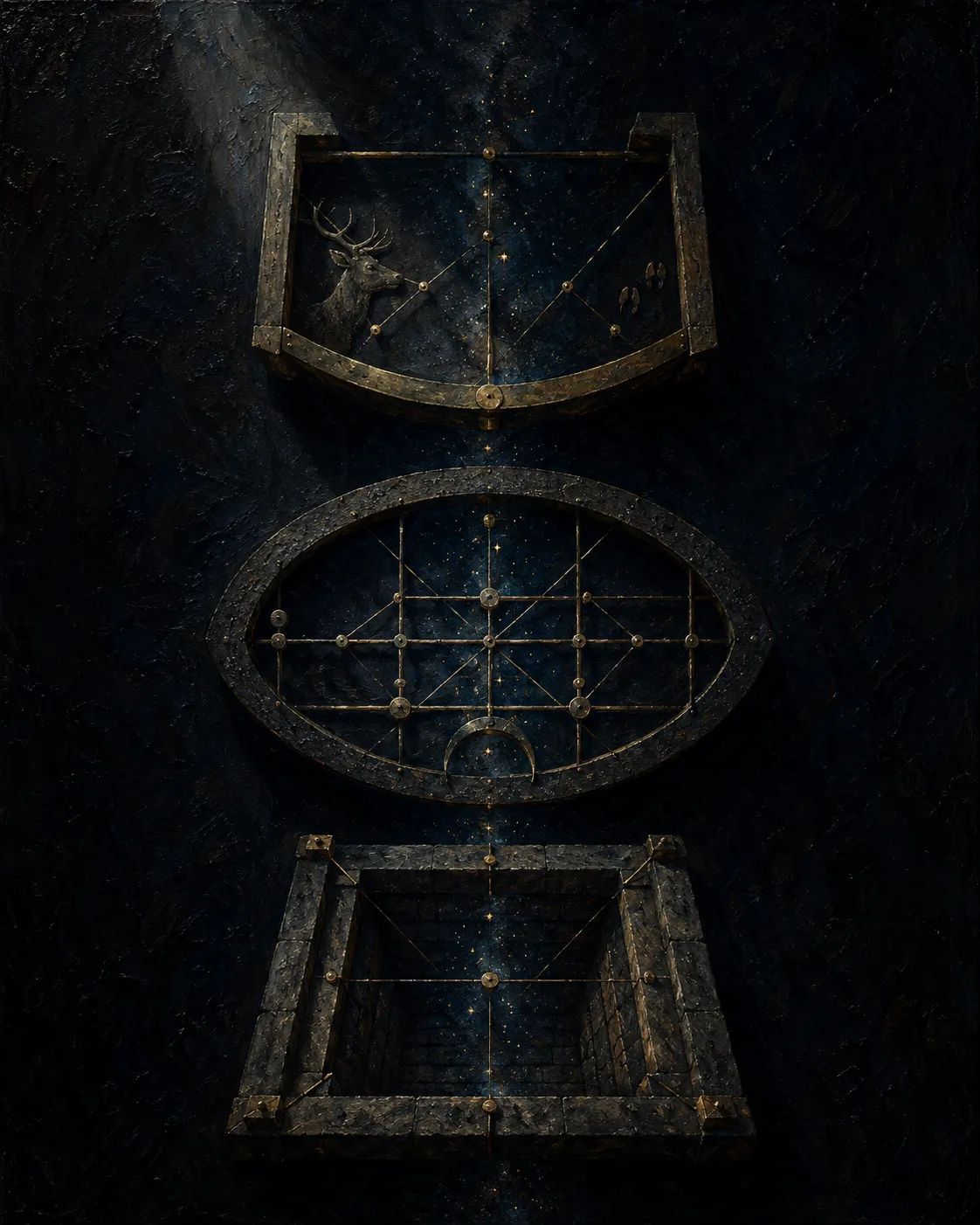
There is a narrow stretch of the ecliptic, the moon’s own belt of sky, that three traditions have looked at and named without any of them knowing the others existed.
The Vedic tradition calls it Mrigashira, the deer’s head. A seeker following a scent it has caught but cannot yet see, moving toward something only just out of reach. The old Arabic tradition, reading the same stretch through its own system of lunar mansions, calls it Al-Han’ah, the brand: not the one who seeks but the one who is marked, set apart, given a function by the mark itself. The Chinese tradition calls it Jing, the well: the built structure that lets a person draw from water that would otherwise stay buried and unreachable.
Seeking. Marking. The structure that lets the seeking arrive somewhere. Three cultures, working from cosmologies that share almost nothing, describing one point in the sky from three different angles and landing, each time, on a piece of the same shape.
᛭
I didn’t come to this as a Catholic looking for permission to try something new. I came to Christianity already carrying years of astrological practice (studying and practising it intensely, every day, as a profession), and the cross-tradition work began there, long before I had a faith to hold it under. When I did convert, the practice didn’t resolve itself neatly. I struggled with it for years. Put it aside sometimes, only to pick it up again later.
The framework I understand it through now came only recently, after studying the history of Catholicism and astrology and finding that the tradition itself had already drawn a line I’d been groping for: a way to let the faith guide the practice rather than abolish it. The convergence between traditions I’d already seen with my own eyes, years before I had any theology to make sense of it.
Medieval scholastics who took both the stars and the faith seriously already considered the same questions as I did, long before me: Hugh of St Victor, Albertus Magnus, Aquinas among them. Aquinas draws the line most plainly: there is a reading of the sky that attends to the quality of a moment, the tone the present hour carries, and there is a reading that tries to forecast what a free will has not yet decided, which the same scholastics rejected outright. The planets incline, Aquinas wrote. They do not compel. The navigator reads the tide. The tide does not steer the ship.
᛭
When I read a chart through more than one tradition’s eyes, I think of it less as blending systems and more as doing what a careful reader has always done with a good observation: taking it seriously on its own terms, then asking, separately, what it means.
I know the temptation to fold different traditions into each other. I tried it, early in my conversion, nine years ago. I was reading Unity Church’s symbolic interpretations of the Bible and watching Santos Bonacci’s esoteric, conspiratorial readings of the Gospels and believing it all: the whole apparatus that dissolves the Incarnation into solar mythology and makes every tradition a dialect of one underlying truth. It felt like freedom. It felt like the biggest possible frame.
Until it didn’t. Until prayer had me down on my knees talking to God again, and I was reminded that however I wanted to abstract or contextualise my faith, it was real regardless of how I chose to understand it. That perhaps there was a certain way it was asking to be understood. Part of my end of the bargain of the relationship, so to speak, was to accept the terms put forward by the Christ as to the basic facts about who He says He is.
That was the end of the collapsing. Not because I stopped respecting what other traditions see (I didn’t, and I haven’t) but because I stopped pretending the seeing was the same as the theology underneath it. The Vedic understanding of karma and rebirth is not the Catholic understanding of grace and resurrection wearing different clothes. These are genuinely different claims about what a person is and what happens to them. Treating them as dialects doesn’t honour either one. It just makes both of them smaller.
It would also be simple to go the other way: to decide that because the theologies can’t be reconciled, the shared reading has to be coincidence. Three cultures each landing on the same mistake by accident rather than each catching a true part of the same thing. I’ve felt the pull of that too, and it isn’t honest about what actually happened.
᛭
What actually happened is plainer than either shortcut. Three traditions that are difficult to reconcile with each other looked at the same point in the sky and reported the same shape from three different directions. I don’t need an explanation more complicated than the one already sitting in front of me: one Author wrote this architecture once, in a form legible enough that unrelated cultures could each read a true part of it in their own language. That’s what a signature does. It holds steady under whatever alphabet is reading it.
I don’t need the traditions to be the same thing for that to be true. I need the sky to be one thing, made by one hand, and read honestly by more eyes than mine.