“In your light we see light.” — Psalm 36:9
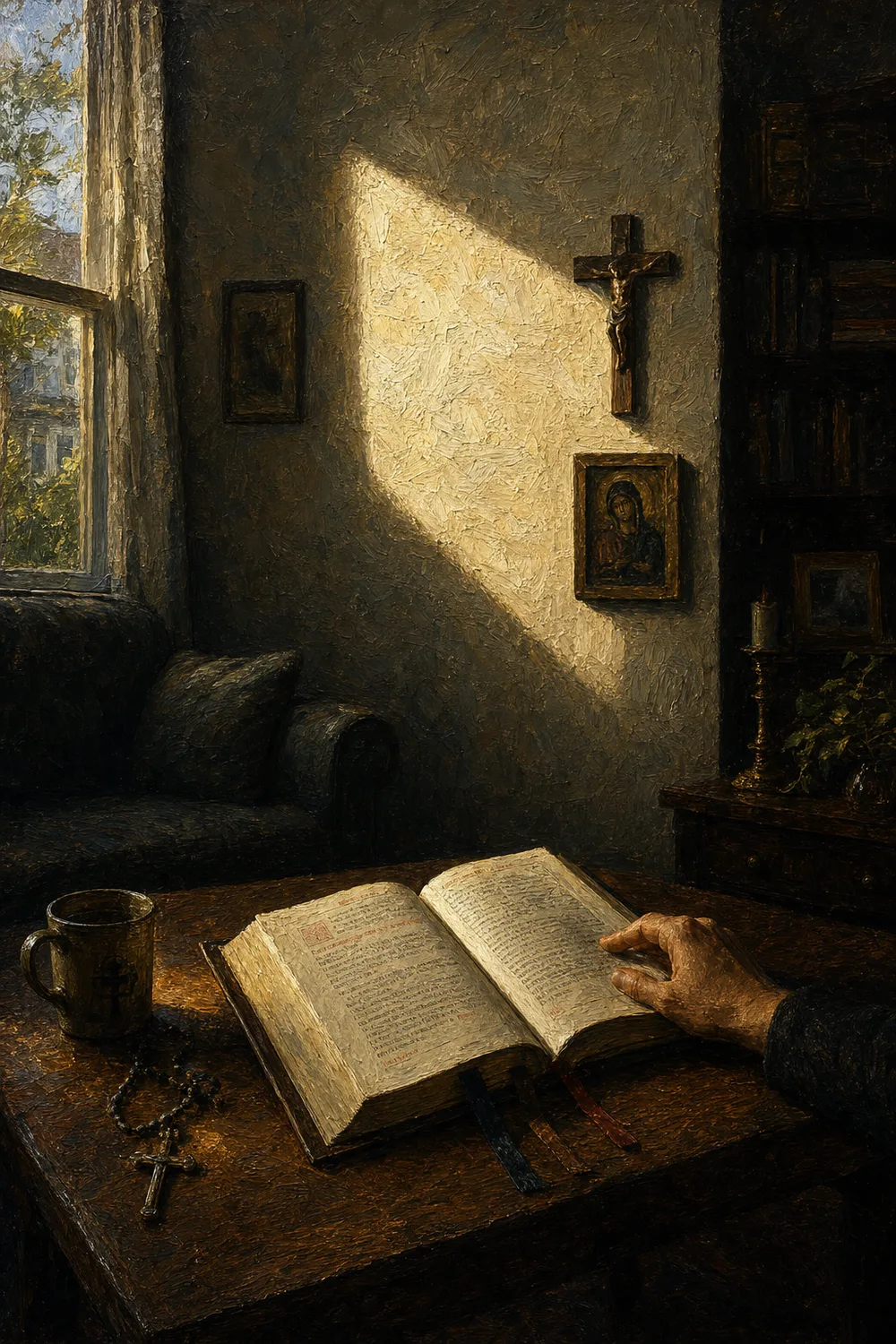
There is a stillness to the morning, settling over the room like a held breath. The air itself seems to pause — not empty, but waiting.
For perhaps an hour it holds. Then it lifts, hardly perceptible at first, until the ordinary weight of the day returns.
᛭
I came to know this stillness by keeping the Little Office of the Blessed Virgin Mary. The same hour, the same room, the same sequence of antiphons — long enough that I began to notice the morning prayer had a different feeling from the hours that come after it.
I am still learning the chant. Following Veronica Brandt’s recordings, finding the tone, losing it, finding it again. There is something nourishing about not quite knowing what I am doing — the attention goes to the prayer itself rather than to the performance of it.
The way the morning, past its first urgency, opens out. The Office is Mary’s in a particular way, and sitting inside it, poorly or well, I find the hour has a special sort of peace to it.
The Psalmist sets the sun in its course and calls it sufficient praise. I think he means it literally. There is nothing metaphorical about the stillness in the air at this hour — it arrives according to the arrangement of things, earth turning at this angle, the day’s demands not yet pressing — and it is simply, plainly good.
᛭
This is not the first time I have kept such an hour. The Japji Sahib names it amrit vela — the ambrosial hours before dawn — the time set aside for remembrance, before the day has had a chance to speak. I rose for it once, in another life, as a practising Sikh. I have fallen in and out of the habit many times since; it is not an easy one to keep. But I have never risen at that hour to pray and felt worse for it.

᛭
The hour passes. The stillness lifts. The room returns to its ordinary hum.
But something carries through into what follows — a residue of attention, or the fact of having stood still long enough to notice something pure. Morning prayer does not change what the rest of the day brings. It makes it legible. Each hour placed against something real, before the demands arrive.
The stillness comes whether I am there or not. I have found, quietly, that it is better when I am.
The Little Office of the Blessed Virgin Mary is a brief, ancient form of the Divine Office, structured around the hours and kept in Mary’s company. Parvum Officium has produced a typeset booklet and a series of chant recordings drawn from 19th-century plain-chant sources. It is a serious piece of work, freely given.