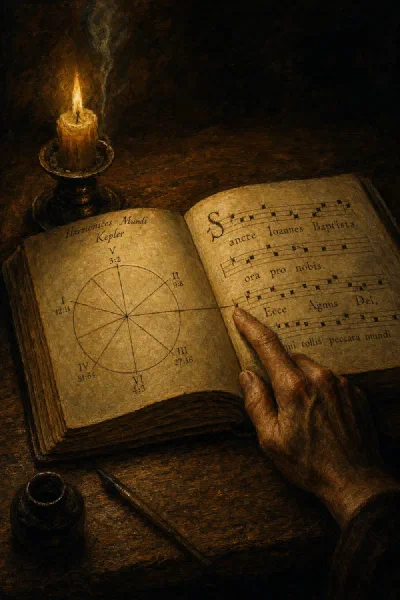
Before the first verse of a psalm there’s a breath, and a note to find. If the pitch has been given, the ear holds on to it for a moment. If it hasn’t, the voice goes looking, tries a place, and either stays there or shifts a little until it sits right.
Then the tone starts. Most of each verse rests on a single note, the words laid out along it one after another; at the half-verse the line bends and comes back, and at the end of the verse it falls. The psalm goes on like that, the same small shape over and over.
Kepler had words for this kind of knowing. In the Harmonices Mundi he wrote that souls rejoice in the proportions God used, wherever they find them, sometimes by thinking it through and sometimes ‘without reflection by the mind, by an instinct which is concealed and was created with them’. He meant every soul God has made. A singer feeling for the note is about the smallest case there is.
᛭
Kepler’s work travels under an older name, the music of the spheres, which can make it sound as though the planets really sing. It’s worth being clear about what he found. Kepler heard nothing with his ears. What he found were ratios: proportions in the speeds of the planets as they go round the sun, which he took to be harmonic — proportions of the same kind as the intervals of music. The harmony was in the motion.
He thought the mind had been made for exactly that. Writing to Maestlin in 1597, he said God had provided us ‘with a mind or intellect’ that ‘was an instrument for the knowledge of quantity like the eye for colors and the ear for sounds’.
As for why the mind and the planets should fit each other, Kepler’s answer was that geometry came first. Geometry, he wrote, ‘before the origin of things was coeternal with the divine mind’, gave God the patterns for making the world, and ‘passed over to Man along with the image of God’. It did not come in, he adds, through the eyes.
᛭
The passage about that hidden instinct goes on to music. Souls, Kepler says, ‘take joy in the harmonic proportions in musical notes which they perceive, and grieve at those which are not harmonic’.
Grieve is a big word for a flat note. I have found that it isn’t too big. Anyone who has sung beside a voice that won’t settle knows the small unhappiness of it, out of all proportion to the size of the mistake, and the relief when the line comes back to what it should be.
So the choir stall and the observatory are closer than they look. The astronomer works the proportion out and the singer hears it; one gets there by arithmetic and the other by ear, and both of them, finding it, are glad. Kepler didn’t think the gladness was an accident.
᛭
Kepler was not the first Christian to think the order of the sky was something like music. What he added was the arithmetic.
Ambrose, in his Hexameron on the six days of creation, passes on the old belief that the spheres give off a sweet tone as they move. He gives it as the philosophers’ view rather than his own, and leaves the question of sound open. Gregory of Nyssa looked at the heavens keeping their courses and the sun’s heat coming down in its rays, and saw in it one divine power going into every part, fitting the parts to the whole and holding the whole together with a single force.
In St Hildegard of Bingen’s Scivias the sun, the moon and the stars obey their Creator as he commands. She allows that a star may now and then carry a sign, by God’s permission. She is also blunt about its limits. She sets the star beside fire and birds, and says that none of them can harm you or help you apart from God.
That last sentence is worth holding on to, for anyone who reads the sky. None of the three is measuring anything. They are saying what the heavens look like to someone who prays, and what the heavens are not for.
᛭
Kepler didn’t think his measuring stood outside that. When he reaches Book V, where the harmonies of the planets are finally set out, he opens it with ‘I commence a sacred discourse, a most true hymn to God the Founder’. What follows is mathematics, and it’s offered as worship.
At the end he lays the working down and prays. The doxology that closes the book begins with the sky:
Praise Him heavens; praise Him, Sun, Moon, and Planets, with whatever sense you use to perceive, whatever tongue to speak of your Creator; praise Him, heavenly harmonies, praise him, judges of the harmonies which have been disclosed; and you also, my soul, praise the Lord your Creator as long as I shall live.
He doesn’t stop to say what sense a planet has, or what kind of tongue. The astronomers are called in alongside the planets, the judges standing in the same line as the things judged. His own soul he leaves till last, after a whole book spent looking outward.
᛭
The psalms of the Office are prayed at their hours every day, in a great many places, whether anyone in particular is there to hear or not. Whoever begins one doesn’t begin the praise. It was under way before the breath was taken: in the motion Kepler measured, in the heavens Hildegard saw doing as they were told, in every other voice already at the psalms.
That’s the posture natural theology asks for. Nobody at the psalm tone is asking the sky what’s going to happen. Kepler talks to the planets, but only to tell them whom to praise. The work is to pay attention to what has been made, and to give thanks for it, out loud if you can.
Kepler left open what tongue a planet might praise with. At every hour of the Office, somewhere, somebody takes a breath and lends one.