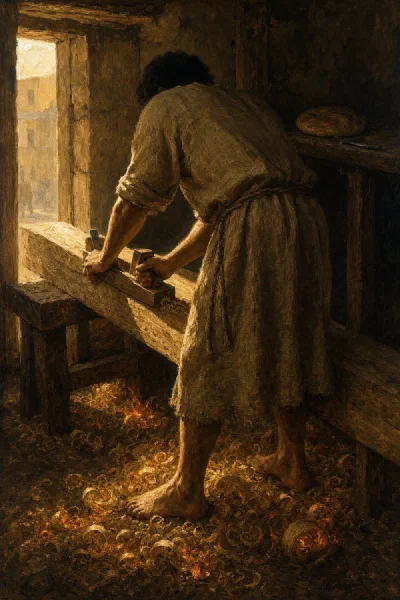
The Gospels give us about three years of Christ in public. Sermons and healings, the crowds that followed him from town to town, the arguments, the meals, the road that ends in Jerusalem.
Before that there are roughly thirty years, and about those they say almost nothing beyond a craftsman, a household that lived by the work of its hands, and bread earned and eaten day after day in Nazareth.
When he came back to teach there, the people who had known him longest were the ones who couldn’t credit he was the same man. Mark keeps their reaction (6:3), and what sticks in their throats is everything they already knew about him, his trade and his family and all the years they’d watched him at work, none of which would fit with the man now teaching in front of them.
The neighbours had had thirty years to see something in him and hadn’t, which tells you a fair bit about what those years looked like from the street.
Later Christians found that silence hard to leave alone, and some of them filled it in. The infancy gospels, written at various points between the second century and the eighth, give Jesus the childhood his neighbours never saw. In one of them, during the family’s flight into Egypt, the two-year-old Jesus climbs down off his mother’s lap and dragons come out of a cave to bow to him. A palm tree bends so Mary can reach the dates, and every idol in a temple crashes to the floor as he’s carried in. Another has him back in Nazareth and a few years older. He makes sparrows out of clay, claps his hands and they fly off, and when another boy runs into his shoulder, Jesus strikes the boy dead.
The Church never let any of them into Scripture, and early church writers dismissed them as fakes, though the stories hung on for centuries in plays and church pictures. It’s not hard to see why people wanted them. A child who makes clay birds fly is a lot easier to pick out as the Son of God than a young man learning a trade and turning up for work.
But the same child kills another boy for bumping into him. The people who told these stories wanted a Jesus nobody could miss, and what they made was a child with the power of God and a child’s temper, which is a frightening combination to have living on your street. Jerome, writing on Matthew, complained about exactly that: a petulant, destructive child who looked nothing like the Christ of the Gospels.
The Gospels left Jesus at the work, and for thirty years nobody on his street had anything to fear from him, or anything much to say about him either.
Put the thirty years beside the three and the silence stops looking like a gap in the record. Whatever God meant to do in a human life, he gave ten parts of it to a workshop and one to the crowds.
᛭
Plenty of people who take God seriously have felt, at one time or another, that the world is Babylon, the city of exile, somewhere a holy life has to get clear of before it can properly start. It’s easy to feel and hard to argue with in the abstract, and the hidden years are about the best answer to it there is. If the world and its work were Babylon, God would not have spent three decades there first. He’d have grown up somewhere set apart and come out when it was time. Instead he worked, and kept on working, for most of his life.
What a holy life has reason to be wary of is worldliness, the grip the world can get on a person. The world itself is a workbench and some neighbours and bread on the table, and Jesus lived among all of it for thirty years without it owning him. Most of us have to live there too, and that’s where we find out whether our faith holds.
The hidden years teach, then, by what’s missing from them. There are no miracles in them, no sermons, nobody keeping notes on a man getting on with his work.
᛭
Jean-Pierre de Caussade was a Jesuit whose letters to nuns dealt with a trouble that was dull and hard at the same time: how to find God in their repetitive daily duties. The letters became a book, Abandonment to Divine Providence, which also goes by The Sacrament of the Present Moment.
What he teaches fits in a couple of sentences. Once a soul is abandoned to God there’s only one rule left, the duty of the present moment, and holiness means being faithful to what God wants in the ordinary task in hand, instead of saving yourself up for great deeds that people will talk about.
He read the Holy Family the same way. They lived by the work of their hands, and for de Caussade the bread they earned made every one of their moments holy, the working ones included, so Nazareth didn’t need anything that came after it to make it count.
Brother Lawrence got to the same place by a rougher road. Before he was Lawrence he was Nicolas Herman, a soldier and then a footman waiting at table, and he went into Carmel as a lay brother because he wanted a steadier, more ordered life.
They put him in the kitchen, and he stayed there thirty years doing work he didn’t like. Yet it was the cook, a plain man with no book-learning to his name, that visitors to the monastery came to see. What he said and wrote survives in a short book, The Practice of the Presence of God, and the line people carry out of it is the plainest one there: ‘I turn my little omelette in the pan for the love of God.’
He found God among the pots and pans, in a job he’d never have picked for himself, and the kitchen he was sent to turned out to be an altar.
It’s hard to say any of this without thinking of another Carmelite. Thérèse Martin, the Little Flower, went into the Carmel at Lisieux in 1888, at fifteen, and died there of tuberculosis at twenty-four. Almost nothing she did inside those walls would have looked like much to anyone else. She wrote her life down because her superiors asked her to, and after she died it came out as Story of a Soul and was read all over the world.
She called what she’d found her little way. ‘Great deeds are forbidden me,’ she wrote. ‘The only way I can prove my love is by scattering flowers, and these flowers are every little sacrifice, every glance and word, and the doing of the least actions for love.’ In 1997 the Church named her a Doctor of the Church, the youngest it has ever named.
᛭
Most people trying to live a holy life are doing it where nobody keeps a record. A few are inside religious houses, with a rule and a bell and a community to hold them to it, but most are at work, or looking for work, or getting by on the margins, with no habit and no rule to tell anyone what they’re trying to do, and from the outside their days look like anyone else’s.
From there it’s easy to treat ordinary life as a waiting room, somewhere to sit out the years before your life with God properly gets going.
I heard the case against that waiting room from the Sikh Gurus before I heard it from anyone in the Church. They refused it outright. Sri Guru Nanak, the first of them, spent years travelling and arguing with the renouncers of his day, yogis with ash smeared on their bodies, rings through their ears and begging bowls in their hands. Then he took off his traveller’s robes, put on plain peasant clothes and settled at Kartarpur, on the banks of the Ravi, where he worked the land himself.
Bhai Gurdas, who wrote out the first copy of the Sikh scripture and whose verses are still sung in gurdwaras, tells the story in one of his ballads. In it a yogi says that going back to the householder’s life is like putting vinegar in milk. Guruji’s answer is blunt: you say you’ve left the household behind, and then you go round to householders’ doors to beg your food.
Sri Guru Nanak set the path out in two lines of his own, and they would have sat easily in Nazareth.
ਘਾਲਿ ਖਾਇ ਕਿਛੁ ਹਥਹੁ ਦੇਇ ॥ ਨਾਨਕ ਰਾਹੁ ਪਛਾਣਹਿ ਸੇਇ ॥
Ghaal khaae kichh hathahu dey, Nanak rahu pachhaaneh sey.
Whoever eats what he’s earned by his own work, and gives some of it away with his own hand, says Nanak, is the one who knows the way.
Guru Granth Sahib, Ang 1245
Nazareth won’t let the waiting room stand either. God spent thirty years there, working and eating and getting older among the same neighbours, and the Gospel, which could have filled those years with signs the way the later stories did, left them almost blank.
Most of the story happened in the workshop, and nobody wrote that part down.