There is a safety in keeping God at a certain distance.
Not the distance of unbelief — something more nuanced than that. The distance of a person who loves truly but knows their own limits. You find your spot. You learn the posture. You settle into the liturgy, the familiar shape of the prayers, the reassurance of the altar fixed at the front of the church where it belongs.
It works. And it is not nothing.
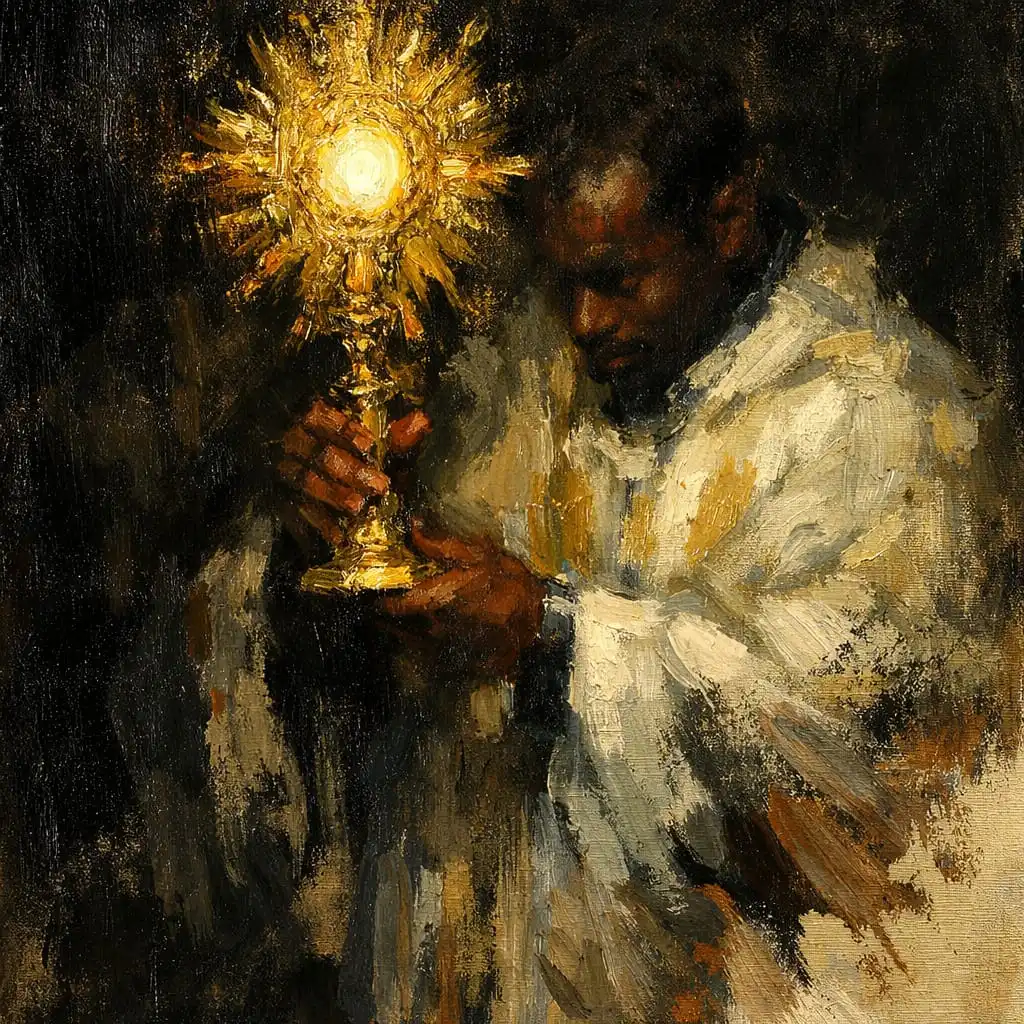
Last night, in the church, I was in that safe place. The Blessed Sacrament — the consecrated bread which Catholics believe to be the living Christ, truly present — rested in the monstrance, its golden vessel, on the altar. The priest spoke. The songs moved through their rhythm. I was holding the encounter at the distance I knew how to hold it.
Then the priest lifted the monstrance and stepped down into the pews.
He moved slowly, row by row, pausing to bless each person where they sat. I watched from the back. Watched the people in the front pews receiving what he was bringing — who he was bringing — this proximity, this unbuffered closeness — and something in my chest already knew what was coming.
By the time he reached me, I could barely look up. The tears had already arrived, ahead of any thought or intention, as though some part of me had understood before my mind did that the gap was closing and there was nothing to do about it.
The impulse, when it came, was total. Every instinct pressing my body toward the floor. Not in despair — in surrender. The kind that the body knows before the mind has named anything. I stayed in my seat. I held myself seated, but bowed, because I felt the room required it, and the tears fell quietly, and I sat with the enormous gap between what the moment was asking and what I felt I could actually do.
᛭
This afternoon I sat with the Manoppello Image — the Volto Santo, the Holy Face — and prayed the Divine Mercy Chaplet.
The church had been an encounter with a Presence. This was an encounter with a face — or so I had assumed.
The image is kept in a small sanctuary in Manoppello, a village in the Abruzzo region of Italy. It is a cloth — roughly the size of a handkerchief, woven from byssus, a rare and ancient sea-silk spun from the filaments of marine molluscs. Byssus does not absorb paint. It has no ground, no primer. And yet a face is on it — precise, wounded, unmistakable — and no analysis has found a trace of pigment or brushstroke to explain how it got there.
The image is double-sided. It shifts with the light. At certain angles it vanishes entirely; at others it resolves into something almost unbearably sharp. A researcher once superimposed its geometry over the face on the Shroud of Turin — the same asymmetrical swelling, the same wounds, the same proportions — with one difference. On the Shroud, the eyes are closed. Here, they are open. Whatever moment this image captures, it is not death.
It looks like a man waking up.
I have spent time with this face over recent weeks. I thought I knew it reasonably well.
᛭
The bruises deepened first. Slowly, across the opening decades of the Chaplet — the familiar prayers moving through their rhythm — marks I had not noticed before began to surface from the fibres. Not dramatically. Insistently. As though the prayer were a kind of developing agent, drawing the Passion out in greater detail than I had previously been permitted to see.
For the sake of His sorrowful Passion, have mercy on us, and on the whole world.
Even though the face I was looking at is printed as an image on paper, the cloth represented seemed to fall away. There is no more precise way to say it. The Face was no longer on the byssus — it was outside of it somehow. Hovering. Three-dimensional and more solid in a way that made the material beneath it seem suddenly irrelevant, a background that had momentarily forgotten its purpose. I looked away. When I looked back, it was already looking at me. Not as though it had turned — as though it had been waiting, patiently, for exactly the moment I returned.
The eyes of the Manoppello face are asymmetrical. One sits fractionally higher than the other. This creates what researchers describe, carefully, as a tracking effect. What it creates, in the room, in the body, is the sensation of being known. Of being the specific object of an attention that does not wander.
By the third decade, the weight arrived.
Not an emotion. Not atmosphere. Weight — physical, pressing, filling the room from the ceiling down.
My head went forward under it before I had decided anything. This is the thing devotional writing rarely mentions: that proximity to the sacred is not always gentle. Sometimes it is simply enormous.
The Hebrew word for glory — kabod — means heaviness. Weight. Not light, not warmth, not the soft gold of a devotional illustration. Pressure. The kind that comes not from threat but from scale.
I heard the prompting clearly enough. Do not be afraid. Keep looking.
I couldn’t. I looked away. I said sorry — quietly, honestly, to the face that was still there regardless of whether I met it. I can’t. I’m sorry, my Jesus. I tried again. A few seconds at most. The weight returned.
This too felt like the night before. The impulse present and the capacity not quite there. The wanting to hold it and the honest inability to. Somewhere between the two: an apology that felt less like failure and more like the truest thing available.
᛭
Last night, when I stepped out of the church and back into the ordinary world, my mind went to work.
The mind went to work — sorting, as it does, for cause. When something happens that has no visible origin, it goes looking for one. The day’s tensions get inventoried. Present worries are examined and tested. Old grievances briefly considered. The tears, the trembling, the strange residue of the encounter — there should be a source for all of this. Something nameable. Something that fits.
There was nothing to find.
I checked. Every candidate came up empty. And there is something clarifying about that moment when the search finally runs out of options — when you have genuinely looked and genuinely found nothing — and the mind goes quiet in the face of data it cannot file. Every candidate came up empty.
The Manoppello face makes no demands. It does not require endurance or readiness or a particular quality of spiritual preparation. It simply remains. Open. Present. Returning the gaze the moment you look back, as though no time has passed, as though your looking away changed nothing fundamental about its attention.
You can say not yet.
It already knew that. It is not going anywhere.
The invitation stands — not as a command, not as a test of courage, not as a performance to be got right. Only as an open door, and a face on the other side of it, and all the time in the world.
The Manoppello Image is kept at the Shrine of the Holy Face in Manoppello, Abruzzo, Italy. The image can be viewed and studied online at various sources — to sit with it even on a screen is to begin to understand what this account is attempting to describe.