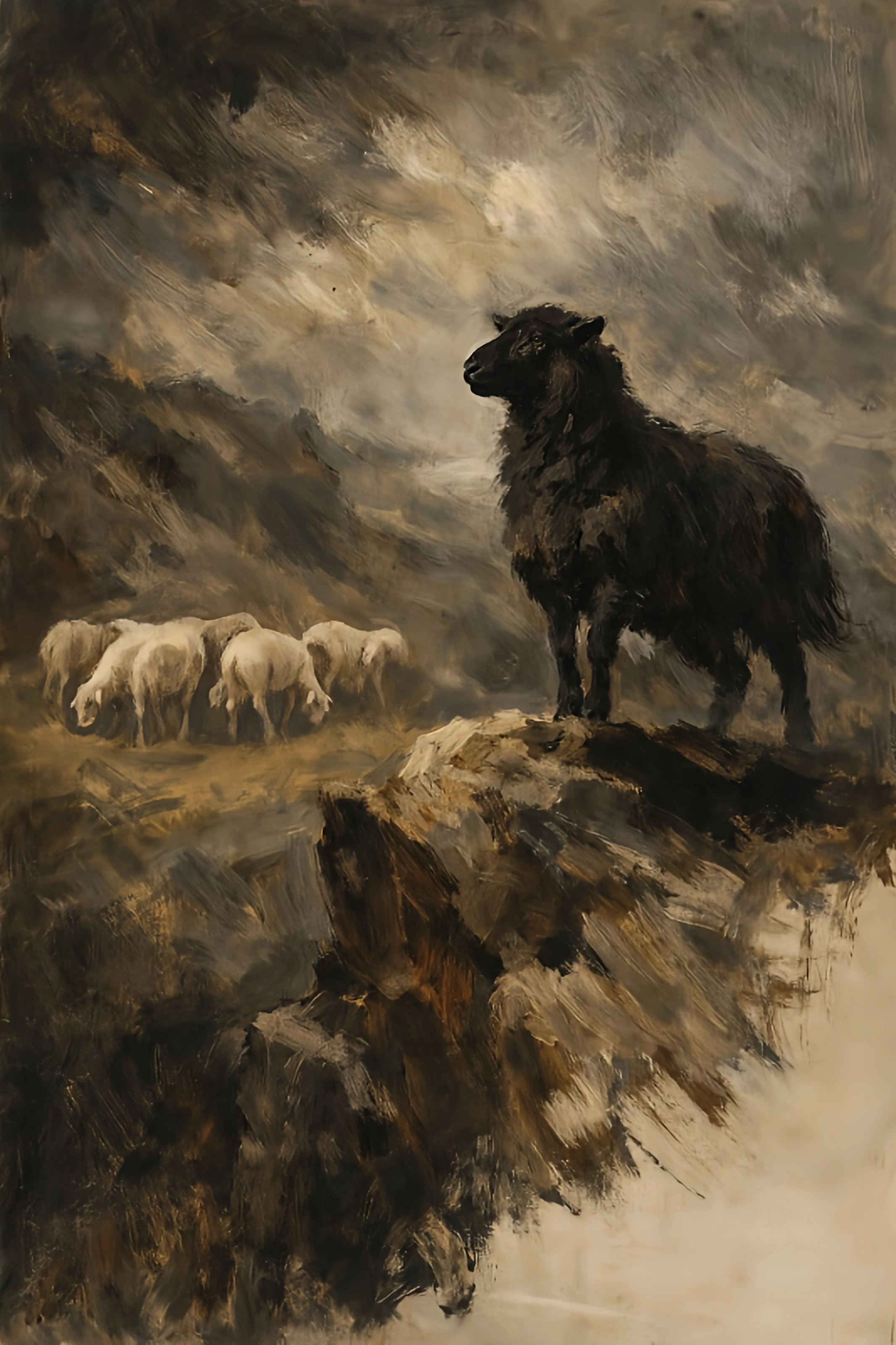
“What man of you, having a hundred sheep, if he has lost one of them, does not leave the ninety-nine in the open country, and go after the one that is lost, until he finds it?” — Luke 15:4
I was baptised in a hotel swimming pool.
A friend did it. No priest, no parish, no sponsor holding a candle. Just chlorine and grace. My friend said the formula and dunked me under and I came up beaming.
That was years before Rome. Before the catechism classes and the RCIA. Before the Easter Vigil, where I stood at the front of a church I had no history in and said yes to things I was still learning how to embody.
I arrived at Catholicism the way you arrive at a place after years of walking — tired, carrying everything, having come through regions that don’t appear on the map the locals use.
᛭
For a long time after, I thought the work was to become someone else. That conversion meant handing in my personality at the door and being issued a new one, sized for the pew. I tried. I prayed to be rid of things that helped me and rid of things that were simply mine. I understood prayer as a slow erosion — grind the edges off, and eventually a saint emerges from the rubble.
It didn’t work. It wasn’t meant to work. I kept at it anyway, because the alternative seemed to be admitting that God had made a mistake, and I had already decided that was not possible.
So if He had not made a mistake, and I still existed, exactly as I was — the question was what to do with that.
I came to a point in my life where I was simply too tired to keep performing. I went to Mass in the body I actually have, with the history I actually have, and nothing caught fire. The roof held. Jesus was still there. The peace I always experienced in His presence was still the same peace.
The shame had been doing all the heavy lifting, and the shame was not from Him.
᛭
There is a feeling that comes when you approach for communion. You walk forward. You kneel, or you stand, and you open your mouth or your hands and receive the Body of Christ — and you believe it, completely, whatever else is unresolved in you.
The Lord does not ask what you did on Saturday. He is simply there. Given. And you receive Him with a life He already knows in full, and He does not flinch.
The shepherd in the story does not describe the lost sheep. There is no explanation of how it wandered off or what it was doing out in the wilderness. He just goes. One hundred, then ninety-nine, then the gap where a life should be. He goes into the gap.
Mary keeps appearing at the edges, too. Lourdes, Fatima, Guadalupe — often to people the institution wasn’t quite sure where to file. Peasant children. The uncredentialled. She comes without a script. What she says is specific, what she asks is specific, and none of it is soft.
She points. She has always pointed. Do whatever He tells you. That is what she said at the wedding in Cana, and that is what she has been saying ever since, to mystics and farmers and frightened children in fields.
On the days the walls of the Church feel most like walls, she is the one who opens the window. Not to show you a way out. To let the air in.
᛭
The Church flickers. I can say this because I love it. It is made of people, and people are limited and sometimes frightened and sometimes wrong. This is the historical record. This is also Tuesday.
The thing the Church is reaching toward does not flicker, though. I have felt it in the silence after the Eucharist when the whole building goes still and there is nothing left to perform. I have felt it at three in the morning with a rosary I learned from YouTube, counting beads in the dark.
He wanted me. Not a better version. Not the version I kept trying to assemble out of other people’s virtues. Me. With the body and the mind and the history and the memory. With all of it. Not because it was all good — some of it was not — but because He is a shepherd, and shepherds do not negotiate with the sheep about the wool.
Black sheep. Still in the flock. Still counted. The wool is the wool.
I am still here.